
 English
 Spanish
 French
 German
 Italian
 Chinese (Simplified)
 Japanese
 Korean
 Arabic
 Portuguese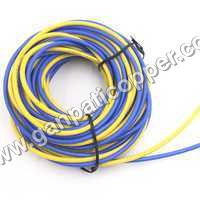
Flexible Copper Cable
1400 INR
Product Details:
- Usage & Applications Power and signal transmission, House wiring, Cable Harnesses
- Core Material Copper
- Conductor Shape Round
- Dielectiric Strength 2.5 kV for 1 minute
- Features Flexible, High Conductivity, Durable, Flame Retardant, Lightweight, Easy to Install
- Core Number 1, 2, 3, 4 or as specified
- Cable Type Flexible copper PVC insulated cable
- Click to View more
X
Flexible Copper Cable Price And Quantity
- 100 Kilograms
- 1400 INR
Flexible Copper Cable Product Specifications
- PVC
- Stranded
- -15°C to 70°C
- Varies depending on length and size
- Pure Copper
- Available in custom lengths
- Flexible Copper Cable
- Varies as per requirement
- Domestic wiring, Industrial wiring, Power supply, Control panels, Electrical machinery
- As per size specification
- PVC (Polyvinyl Chloride)
- PVC
- 0.5 sqmm to 16 sqmm
- Indoor/Outdoor
- 1, 2, 3, 4 or as specified
- Copper, PVC
- >15 N/mm²
- Flexible copper PVC insulated cable
- 1, 2, 3, 4 or customized
- 50 Ohm (typical for signal cables)
- Not Armored
- -15°C to 70°C
- Copper
- Power and signal transmission, House wiring, Cable Harnesses
- Black, Red, Blue, Green, Yellow (as required)
- 2.5 kV for 1 minute
- Black
- Flexible, High Conductivity, Durable, Flame Retardant, Lightweight, Easy to Install
- -20°C to 60°C
- Up to 1100V
- Round
- Depends on cross-sectional area (refer to standard chart)
- Yes
- 160C (for maximum 5 seconds)
- Minimum 0.9 mm depending on cable size
- IS 694 certified (as per Indian Standards)
- 50/60 Hz
- Class 5 (Finely Stranded Conductor as per IEC 60228)
- Yes, suitable for outdoor installation
- No (standard PVC insulation)
- Yes
Flexible Copper Cable Trade Information
- 5 Days
Product Description
Flexible copper cable is a type of electrical cable that is designed to be highly flexible, making it ideal for applications where the cable needs to bend, twist, or move around. It is made of copper wires that are stranded together and covered in a protective jacket.
The stranding of the copper wires provides the cable with its flexibility, allowing it to bend and flex without breaking or cracking. The number of strands and the thickness of the wires can vary depending on the specific application and the amount of flexibility required.
Flexible copper cable is commonly used in a variety of applications, including robotics, automation, and machinery where the cable needs to move along with the equipment. It is also used in applications where the cable needs to be installed in a tight space or where there is a risk of vibration or movement that could damage a more rigid cable.
Overall, flexible copper cable offers a number of advantages over rigid cable, including improved flexibility, durability, and resistance to damage from bending and flexing. It is a popular choice for many different types of electrical and industrial applications.
Engineered for Safety and Durability
This cable meets stringent Indian (IS 694) and international (IEC 60228) standards, designed to deliver consistent performance in challenging conditions. Its hardwearing PVC insulation, flame retardancy, and UV resistance guarantee robust operation, whether installed outdoors or inside electrical panels.
Wide Application and Flexibility
Suitable for house wiring, industrial power supply, cable harnesses, control panels, and electrical machinery, the flexible copper cable is available with 1-4 cores or more for custom specifications. Its finely stranded pure copper conductor ensures flexibility and easy routing, even in tight spaces.
Compliance and Customization
The cable is RoHS compliant and crafted with environmental considerations in mind, except for its halogen content due to standard PVC insulation. Offered in varied sizes, lengths, and colors, it is manufactured to fit diverse installation needs and technical requirements, meeting both performance and regulatory expectations across India.
FAQs of Flexible Copper Cable:
Q: How can I determine the maximum current capacity for these flexible copper cables?
A: The maximum current capacity depends on the cross-sectional area of the cable; you can refer to the standard IS 694 current rating charts for precise values according to your selected cable size.Q: What makes this cable suitable for outdoor installations?
A: These cables feature oil and UV resistance, as well as flame-retardant PVC insulation and jacket, ensuring reliable performance even in harsh weather and sunlight when installed outdoors.Q: When should I opt for Class 5 flexibility in wiring applications?
A: Class 5 finely stranded conductors are recommended when you require ease of installation, repeated movement, or when space routing demands flexible cables, such as in control panels, machinery, or cable harnesses.Q: Where can these cables be used?
A: They are ideal for a range of environments, including domestic electrical wiring, industrial power distribution, control panels, cable harnesses, and electrical machinery, both indoors and outdoors.Q: What is the process for ordering custom length and configuration?
A: To order cables in your required length, core number, and color, you can specify your technical and dimension requirements during your order. Options are available for core count, size (0.516 sqmm), and jacket color.Q: How does the flame-retardant feature benefit users?
A: Flame retardancy provides crucial safety by reducing the spread of fire, protecting both property and individuals during electrical faults in domestic or industrial settings.Q: What should I know about the insulation and halogen content of these cables?
A: The insulation and jacket are made from standard PVC, which is durable and flexible, but not halogen-free. This is typical for general-purpose cables as per IS 694 standards.Tell us about your requirement

Price:
Quantity
Select Unit
- 50
- 100
- 200
- 250
- 500
- 1000+
Additional detail
Mobile number
Email

Other Products in 'Flexible Cables' category




Contact Us

- C-27, Bais Godam Industrial Estate, Bais Godam, Jaipur - 302006, Rajasthan, India
- Phone : 08045802792
GANPATI ENGINEERING INDUSTRIES
GST : 08AABFG6654R1ZQ

- Mr Anup Gupta (Partner)
- Mobile : 08045802792
- Send Inquiry
- Mobile no :-919414048492
 Send Inquiry


GANPATI ENGINEERING INDUSTRIES
All Rights Reserved.(Terms of Use)
Developed and Managed by Infocom Network Private Limited.
Developed and Managed by Infocom Network Private Limited.

